For years, the digitalisation of infrastructure focused on achieving visibility. The goal was to gain a clearer understanding of what was happening on the ground, access real-time information, and reduce dependence on manual processes. That objective has been more than achieved. Today, control centres receive data from thousands of devices, systems and applications deployed across infrastructure networks. Roads, tunnels, tolling systems, metro and bus networks, urban traffic platforms, water infrastructure, energy facilities and Smart City services continuously generate information on operations, asset condition, environmental conditions and user behaviour. The challenge has now shifted. The question is no longer how to obtain more information, but how to extract the knowledge needed to operate increasingly complex systems.
And this is far from a minor change. For a long time, the main challenge for a control centre was simply knowing what was happening. Today, in many cases, the challenge is identifying what truly matters among thousands of events competing simultaneously for operators’ attention.

Anyone involved in operations will recognise this situation. Alarms, incidents, alerts, performance indicators, weather data, information from field equipment, events reported by external systems and behavioural patterns detected by different applications flow continuously into the control centre. Having access to all this information is undoubtedly an advantage. The problem is that human attention remains limited.
In reality, many of the capabilities required to integrate information have existed for years. Centralised monitoring, event correlation, operational support systems and integration platforms have long been part of critical infrastructure operations. What is evolving today is not so much the ability to collect information, but the ability to determine which information requires action, which events are part of the same operational situation, and which decisions should take priority at any given moment.
The issue is no longer a lack of visibility. It is the management of attention.
When an infrastructure operates normally, thousands of events may occur every day without requiring any significant intervention. However, when a major incident arises, the situation can change rapidly. An accident may disrupt urban mobility far beyond the location where it occurs. Severe weather conditions can simultaneously affect traffic, public transport and the operation of water infrastructure. At the same time, coordinated actions may be required across multiple services responsible for managing the situation, along with the timely dissemination of reliable information to citizens in order to minimise risks and support decision-making. A failure in what appears to be a secondary system can trigger cascading effects across other operational areas. The reality of infrastructure is rarely built around isolated events, but rather around relationships that are not always immediately obvious.
This is why one of the most significant developments taking place in control centres is the growing ability to contextualise information. For years, the objective was to display data. Today, it is increasingly important to understand what that data means within the operational situation unfolding at any given time.
The distinction may seem subtle, but it fundamentally changes the role of technology. It is no longer simply about displaying alarms, but about helping operators understand which alarms are related. It is no longer just about identifying incidents, but about understanding which ones are likely to impact service delivery. It is not simply about having real-time information, but about presenting it in a way that supports a fast, coordinated and effective response.

This shift is driving a new generation of operational environments in which decision support is playing an increasingly important role. This does not necessarily mean replacing operators or moving towards complete automation. Infrastructure systems are far too complex, with operational, economic and safety implications that make absolute automation unrealistic. Instead, the focus is on using technology to reduce operational complexity and help those responsible for managing infrastructure make better-informed decisions.
The value emerges when a system can identify patterns that would otherwise go unnoticed, correlate information from different operational domains, or highlight events that require immediate attention while distinguishing them from those that can be addressed later. In other words, when it can transform information into context.
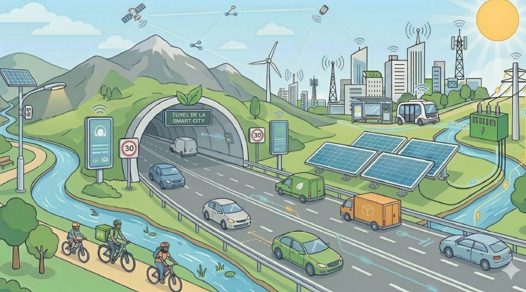
This need is emerging across virtually every sector. Mobility can no longer be understood solely from the perspective of a single road or public transport line. Water resource management increasingly depends on the integration of hydrological, meteorological and operational information. The value of this information lies not only in improving infrastructure operations, but also in supporting coordinated decision-making that helps anticipate problems, mobilise resources and keep citizens informed. Urban environments bring together traffic, transport, energy, security and municipal services. As interdependencies between systems continue to grow, operating each domain in isolation becomes increasingly difficult.
Benefits are also beginning to emerge beyond incident management. A deeper understanding of what is happening across infrastructure networks makes it possible to optimise resources, anticipate operational requirements, improve planning and make better use of existing assets. In many cases, relatively small improvements in the way information is interpreted can have a significant impact on operational efficiency, resource consumption and service quality.
Viewed from a broader perspective, the evolution is clear. For years, enormous effort was invested in connecting infrastructure, deploying sensors and generating data. That work was essential and remains the foundation for everything happening today. But the real differentiator no longer lies solely in the ability to collect data.
The difference increasingly lies in the ability to understand it, prioritise it and turn it into meaningful actions within the timescales that operations demand.
Because infrastructure already generates more information than any individual can analyse alone, and it is likely to continue generating even more in the years ahead. The question is no longer how much we know about our infrastructure, but how effectively we use that knowledge to operate it. This is where one of the most profound transformations of recent years is taking place: the shift from managing information to managing decisions. And it is precisely in this area that the new operational intelligence of infrastructure is being built.