Municipalities, universities, hospitals and other public sector organisations are facing a challenge that goes far beyond reducing energy costs. The need to advance sustainability goals, strengthen infrastructure resilience and make more efficient use of available resources is driving a new approach to the energy transition.
Yet budget availability remains one of the main factors limiting the deployment of new energy infrastructure. In many cases, the technology is readily available, the potential savings are clear and decarbonisation targets are already in place, but the required investment must compete with other operational priorities.
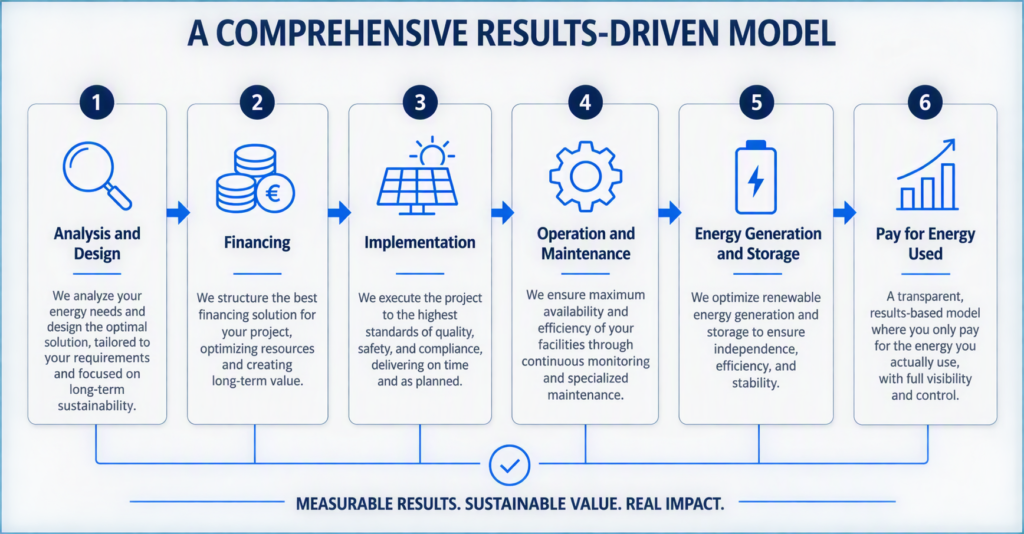
In this context, energy performance contracts are emerging as an effective way to accelerate the adoption of renewable self-consumption systems. Under this model, an Energy Services Company (ESCO) takes responsibility for the design, financing, implementation and operation of the installation, enabling the contracting organisation to benefit from modern energy infrastructure without the need for significant upfront investment.
However, the real transformation lies not only in who finances the installation. What is changing is the shift from owning energy assets to procuring energy outcomes.
The concept goes beyond the installation of solar panels. It involves turning a one-off capital investment into an ongoing service, where renewable generation, energy storage, monitoring and operations are integrated into a single strategy focused on maximising the value of the energy produced.
From Capital Investment to Energy as a Service
Unlike traditional models, where public sector organisations fund the infrastructure themselves and remain responsible for its operation and upkeep throughout its lifecycle, this approach takes a different path. Rather than procuring a photovoltaic installation alone, the organisation acquires a long-term managed generation service designed to optimise the use of renewable energy and ensure sustained performance over time.
The Energy Services Company (ESCO) can assume responsibility for the investment required to deliver a fully integrated system, including:
- Photovoltaic modules and inverters
- Mounting structures and electrical protection systems
- Engineering, design and regulatory approvals
- Monitoring and metering systems
- Battery energy storage systems
- Energy management tools
- Comprehensive operations and maintenance
- Performance and availability guarantees
Under this model, the investment is recovered progressively through the delivery of the service, aligning the interests of both parties around the efficient operation and long-term performance of the infrastructure.
A Performance-Based Model
Once the installation is operational, remuneration is typically linked to the amount of renewable energy actually consumed by the organisation. In broad terms, the model follows a straightforward principle:

This approach introduces a significant shift. Financial compensation is no longer tied simply to the existence of the infrastructure itself, but to the value the energy system actually delivers. The better the installation performs and the greater the volume of renewable energy utilised, the greater the benefit for all parties involved.
To support this model, installations are equipped with advanced monitoring systems capable of tracking photovoltaic generation, self-consumption levels, energy storage performance and key operational indicators. Access to this data enables much more precise oversight of energy assets and supports decision-making based on objective performance metrics.
In addition, these contracts typically include service quality and availability indicators that encourage efficient operation throughout the project’s lifecycle. As a result, energy is no longer viewed solely as a physical asset, but as a continuously managed service.
The Growing Role of Energy Storage
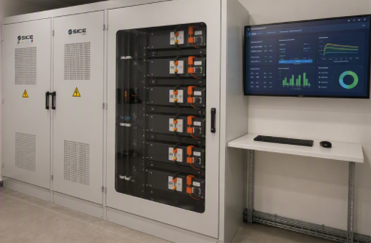
The integration of energy storage systems is adding a new dimension to these projects. While photovoltaic generation is concentrated primarily during daylight hours, the energy demand of public buildings is typically spread throughout the day. Energy storage makes it possible to shift part of the renewable energy generated to periods when demand remains high but solar production is lower.
The ability to manage when energy is used is becoming almost as important as the ability to generate it. Batteries not only help increase self-consumption rates but also provide greater operational flexibility and support a more efficient use of available energy resources.
As a result, energy storage is evolving from a complementary component into a strategic element of energy infrastructure management. The combination of distributed generation, storage and advanced monitoring is paving the way for smarter operational models, capable of adapting to increasingly complex and dynamic consumption patterns.
An Opportunity for the Public Sector
This approach is particularly well suited to organisations with substantial and relatively predictable energy demand, where a significant share of locally generated electricity can be consumed on site. Administrative buildings, university campuses, healthcare facilities, sports complexes, municipal markets, car parks and urban service infrastructure are just some examples where this model can deliver tangible benefits.
Its success, however, depends on rigorous upfront analysis. The objective is no longer to install the greatest possible generation capacity, but to identify the optimal balance between generation, storage and demand. Increasingly, understanding how an asset consumes energy will be just as important as the ability to generate it.
Ultimately, energy performance contracts represent a new way of approaching the energy transition. Beyond facilitating the adoption of renewable energy and overcoming investment barriers, they reflect a broader shift from asset ownership to performance-based energy management.
As public infrastructure continues to advance its digitalisation journey, the integration of renewable generation, energy storage, monitoring and operations will become a key factor in improving efficiency, strengthening energy resilience and meeting evolving sustainability requirements. The challenge is no longer simply to generate clean energy, but to manage it intelligently in order to maximise the value of every kilowatt-hour produced.