Efficient and sustainable water management depends largely on the quality of the hydrometeorological data that feed information systems. Data validation is a fundamental technical process that ensures the accuracy and reliability of the information used for decision-making, ranging from hydrological planning to risk management and ecosystem protection.

Regulatory framework in Spain
In Spain, the validation of hydrometeorological data is supported by a robust regulatory framework. The Water Framework Directive (WFD, 2000/60/EC) establishes the obligation for European Union Member States to achieve and maintain a good ecological and chemical status of all water bodies. To this end, it requires the implementation of monitoring programmes and the development of river basin management plans based on reliable and validated data.
At a technical level, Standard UNE 500540:2004 defines guidelines for the validation of meteorological records from automatic monitoring networks, structuring the process into different validation levels:
- Level 0: Validation of the data record structure.
- Level 1: Physical limit checks.
- Level 2: Temporal consistency of the data.
- Level 3: Internal consistency of values.
- Level 4: Temporal consistency of the time series.
- Level 5: Spatial validation through comparison with correlated stations.
- Level 6: Visual validation.
This methodology ensures that data are coherent, complete, and representative of actual hydrological conditions.
Why is validation so important?
Hydrological data validation is the cornerstone of integrated water management in Spain. Validated data enable:
- Hydrological planning: The development of river basin and national plans based on efficiency and sustainability criteria.
- Pollution control: Assessment of water status and verification of compliance with environmental objectives.
- Risk management: Prediction and mitigation of floods and droughts, phenomena that are becoming increasingly frequent due to climate change.
- Water allocation: Ensuring fair and sustainable distribution of the resource among different sectors.
- Protection of the public hydraulic domain: Delimitation and safeguarding of sensitive ecosystems such as wetlands and riparian areas.
In Spain, floods account for approximately 65% of compensated damages related to extraordinary risks, highlighting the critical need for reliable and consistent data to analyse and mitigate these events.
Technological innovation in data validation
In recent years, hydrometeorological data validation has evolved significantly thanks to the incorporation of advanced technologies. High‑precision sensors, real‑time communication systems, artificial intelligence and big data enable process automation, anomaly detection and improvements in data quality. These innovations not only streamline validation procedures but also facilitate the integration of large volumes of information, thereby optimising water resource management.
Hydrometeorological data validation is a global priority in water management. Countries such as the United States, Australia and Germany have developed advanced monitoring and validation systems, integrating technologies similar to those implemented in Spain.
The Ebro AHIS: an international benchmark in water management
The Ebro Automatic Hydrological Information System (AHIS) is a paradigmatic example of how robust data validation can position a river basin as an international benchmark in water management. This system integrates more than 2,000 stations and processes real‑time data every 15 minutes, enabling continuous monitoring and rapid response to any incident. The Ebro AHIS stands out internationally not only for its technological capacity, but also for the robustness of its validation processes and the transparency of its information management.
Validation process within the Ebro AHIS
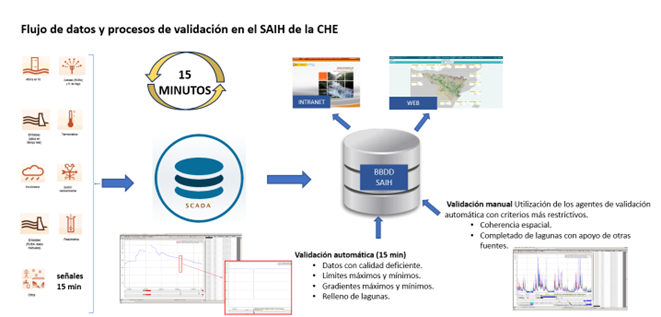
The data flow within the Ebro AHIS combines automated and manual validation procedures:
- Automated validation (every 15 minutes): Checks physical limits as well as spatial and temporal consistency, and generates incident reports to enable early intervention.
- Manual validation: Validation agents apply more restrictive criteria, review spatial consistency and complete data gaps using information from other sources.
One of the most notable tools is the incident reporting application, which allows erroneous or unlikely data to be quickly identified and maintenance teams to be alerted. Examples such as the detection of a clogged rain gauge or the identification of anomalous flow values illustrate the system’s effectiveness and its direct impact on decision‑making — from flood emergency management to the optimisation of resources for irrigation and urban water supply.
Looking ahead: quality, collaboration and resilience
Hydrometeorological data validation has become a strategic pillar for ensuring safety, sustainability and efficiency in water management. Through the integration of advanced technologies and the application of rigorous regulatory frameworks, current systems are able to provide accurate and reliable information, which is essential for risk anticipation, resource planning and ecosystem protection.
The Ebro AHIS case clearly demonstrates that a strong commitment to data quality not only enhances the capacity to respond to extreme events, but also strengthens transparency and trust among all stakeholders involved in water management. Collaboration between public administrations, technology providers and end users is key to continuing progress towards smarter and more resilient water governance.
In a context increasingly shaped by climate change and growing pressure on water resources, investing in data validation and the continuous improvement of information systems is an investment in the future. Only through this approach will it be possible to ensure both the availability and quality of water for future generations, successfully addressing the challenges that lie ahead.