In the years following World War I, Spain was gripped by a severe economic crisis. The collapse in steel demand and the loss of competitiveness against countries with depreciated currencies forced investments to shift toward emerging sectors such as electricity. In this climate, the opportunity arose to modernize critical infrastructure through electrification—a field that promised stability and growth amid industrial uncertainty.
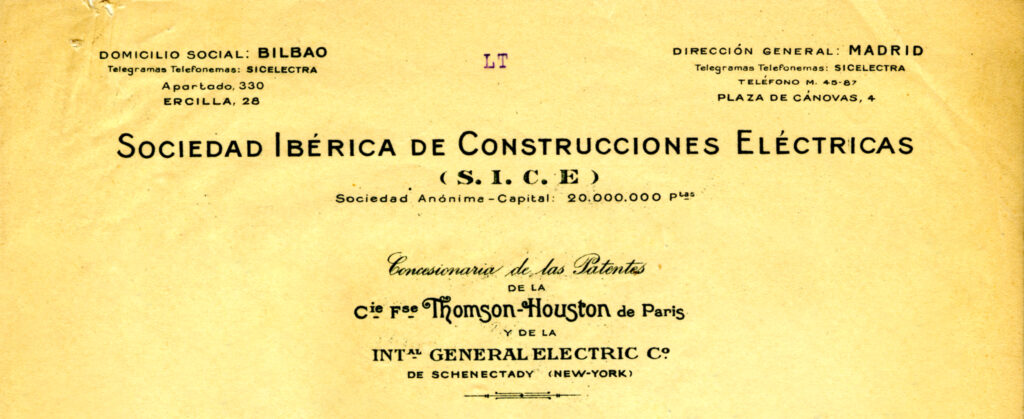
In 1921, the Sociedad Ibérica de Construcciones Eléctricas (SICE) was established. Conceived as a Spanish company, it was born from a strategic alliance between the American General Electric and the French Thomson-Houston—two global technology leaders that contributed not only capital but also access to advanced patents and industrial systems. The company’s founding charter set out a clear mission: to electrify industries and transportation, install power plants, lines, and substations, and develop signaling and communication systems. To achieve this, SICE committed to manufacturing and assembling electrical equipment based on its partners’ patents.
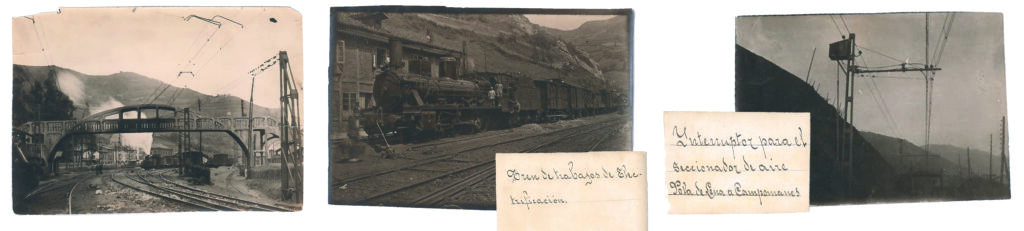
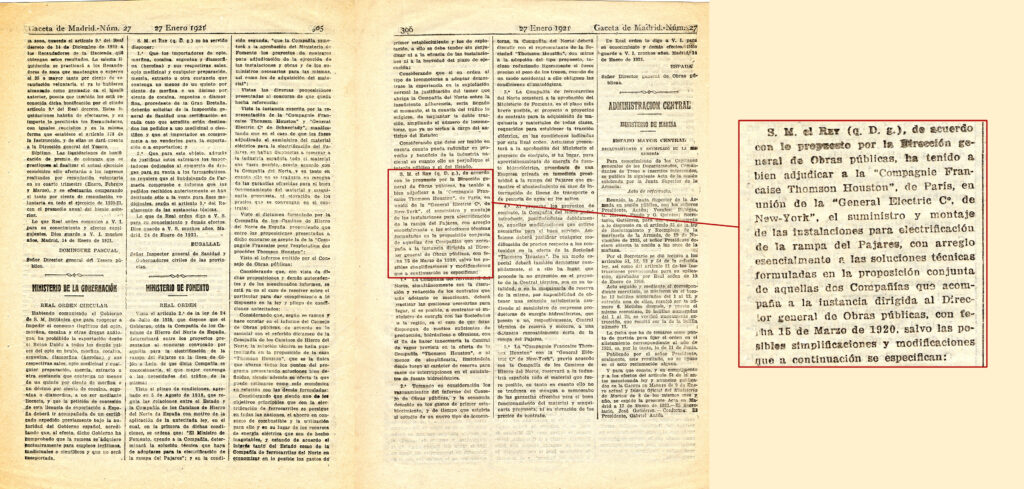
SICE’s first major project was the electrification of the Pajares mountain pass. This landmark undertaking not only marked the beginning of electric traction on one of Spain’s most challenging railway routes but also embodied the company’s purpose: applying technological innovation to modernize the nation. That a Spanish company was created with foreign partners made perfect sense at the time, when economic crisis and the lack of domestic technology demanded international alliances to tackle projects of such scale.
A Strategic Project for Modernization
The electrification of the Pajares mountain pass emerged as a response to an urgent need: to modernize rail transport at a critical moment for Spain’s economy. Steam locomotives, once indispensable, had become a liability—they polluted, were inefficient, and posed safety risks for transporting coal from Asturias to León, a resource that was vital amid the post-war fuel crisis. The situation was further compounded by the collapse of the steel industry and the difficulties in exporting, as other countries offered lower prices thanks to currency depreciation.
In this context, electrifying Pajares was far more than a technical upgrade; it was a strategic move to drive the country’s industrial recovery. What made the project exceptional was that Spain had no prior experience with railway electrification on this scale. There were no models to follow, no proven solutions, and no specialized teams. That SICE embraced this challenge from its inception speaks volumes about its extraordinary capacity for innovation and resilience.

Electrifying this route was anything but simple. The engineering of the early 1920s had to contend with one of the most demanding lines in the country. For this reason, the project adopted a high-voltage direct current system, based on several factors:
- The high cost of acquiring substation materials and their transit through France.
- The complications of diverting telephone and telegraph lines if a single-phase system were chosen.
- The challenges of insulating the catenary in humid tunnel environments like Pajares.
- The advantages of regenerative braking.
- The excessive weight of single-phase equipment.
The starting point lay in the electrification guidelines drafted in 1917. These did not merely state an intention; they defined how to achieve it. Those pages specified the 3,000-volt solution and the framework within which everything else had to fit—from performance in long tunnels to safety conditions on a demanding route.
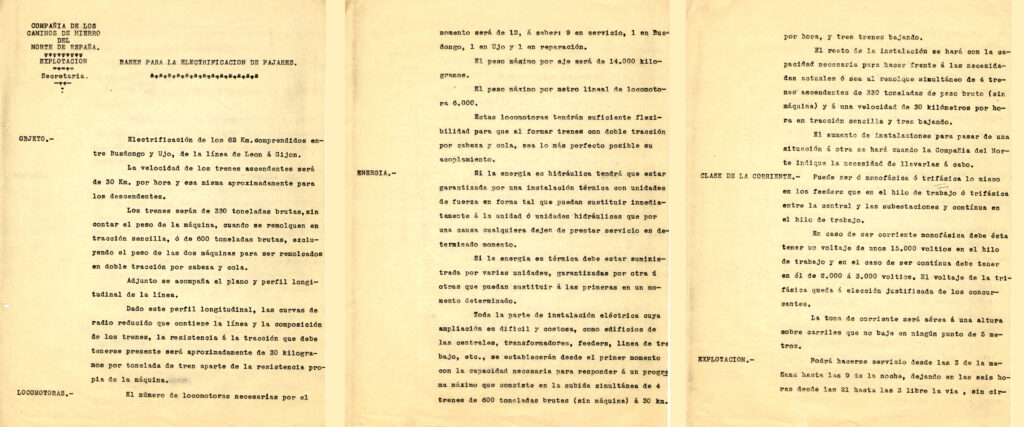
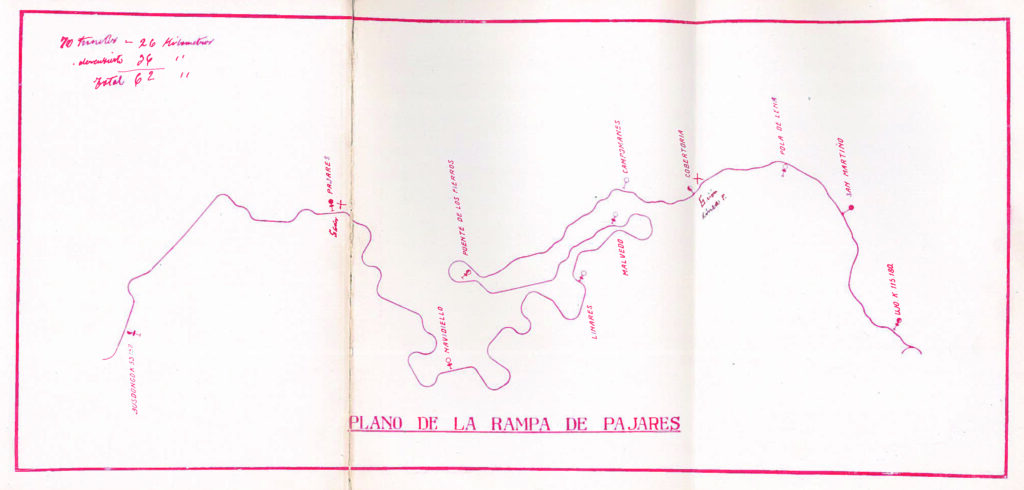
The plan established that electrification would cover a 62-kilometer stretch between Busdongo and Ujo. Train speeds were set at 30 kilometers per hour for both ascending and descending runs, with a gross weight of 330 tons. Given the line’s challenging profile—with tight curves and complex train compositions—it was essential to ensure a traction resistance of 30 kilograms per ton.
An Unprecedented Challenge
The Pajares mountain pass was one of the most demanding railway routes in Spain, with long tunnels, sharp curves, and harsh weather conditions. Electrification required innovative solutions and international coordination. SICE took on the responsibility of supplying locomotives—manufactured by General Electric—along with converters, transformers, substation panels, and other essential equipment.
A detailed list of additional materials was drawn up, together with a system for tracking the status of deliveries at every stage. Proposed solutions were continuously reviewed and refined, applying improvements as the project advanced. Each contract and every signed document marked milestones that transformed the ambition to modernize into concrete commitments.
Beyond engineering, the project meant overcoming logistical and financial barriers during a severe economic crisis. Coordinating international supplies, adapting cutting-edge technology, and meeting deadlines in an adverse environment was a true test of vision and organizational strength. The success of the electrification established SICE as a pioneer in electrical engineering in Spain, proving that innovation and strategic foresight can turn an unprecedented challenge into reality.
More Than a Project: The Beginning of a Vision
The electrification of the Pajares mountain pass was not merely a technical achievement; it was proof that innovation can forge paths where none exist. In a country with no prior experience in railway electrification, amid economic crisis and limited resources, SICE embraced the challenge of transforming mobility and laid the foundation for a new industrial era.
This project did more than modernize a railway line—it marked the birth of a company that understood progress is built on boldness, knowledge, and collaboration. From that first challenge, SICE has remained true to its essence: turning technology into solutions that improve people’s lives. Pajares was the starting point, but also the enduring symbol of a conviction that remains alive more than a century later: when innovation meets determination, the future becomes possible.