Solar photovoltaic energy has become one of the pillars of the energy transition. In Spain, its growth has been steady and far-reaching: we closed 2025 with more than 8.7 GW of accumulated self-consumption, and the National Integrated Energy and Climate Plan (PNIEC) sets an ambitious target of 19 GW for 2030, along with 76 GW of total photovoltaics and 22.5 GW of storage. Translated into deployment pace, the country must triple the speed of project commissioning in the coming years and do so more intelligently than ever: not just installing, but integrating and operating with criteria of grid stability, efficiency, and sustainability.
This phase change was clearly seen in 2025, when photovoltaics broke the annual generation record and increased the renewable share of the energy mix, but also saw a rise in technical curtailments and episodes of very low or negative prices during certain solar hours. It’s logical: the sun produces at midday, and demand doesn’t always match. The system needs flexibility—batteries, smart management, and grid reinforcements—so that solar energy is useful when needed and where the grid can accept it. Spain has also seen peaks of non-integrable renewable energy close to 10–11% during the summer, which has accelerated the conversation about storage and hybridization.
Meanwhile, the regulatory framework is advancing. Royal Decree 244/2019 established self-consumption modalities with and without surplus, simplified compensation ≤100 kW, and collective self-consumption. The update planned for 2026 will extend the proximity radius up to 5 km in certain cases and regulate distributed storage and shared surpluses, opening the door to more functional energy communities, industrial parks, and municipalities with “neighborhood” solutions. The underlying message is clear: sharing and storing will be as important as generating.
Against this backdrop, a modern photovoltaic plant is no longer just “putting up panels and that’s it.” It’s an orderly process that starts long before the first structure is installed and continues for decades during operation. And although this article includes technical parts, the main message is easy to follow: the better it’s designed and operated, the more energy is harnessed and the fewer problems there are for the grid and the environment.
From Design to Operation: How a Modern Plant Is Built
It all begins with site analysis. In everyday language: knowing how much light there is, how it heats, how the wind blows, what shadows buildings or terrain cast, and what access and environmental constraints exist. With this snapshot, the orientation and tilt of the panels are decided, the spacing between rows, and whether to use fixed structures or trackers (mechanisms that orient the panels throughout the day). This phase, which sometimes seems like a formality, makes the difference between a project that performs and one that is frustrated by losses and rework. (This preliminary work on resource and geometry is standard in the best projects and is reflected in the sector’s technical guides and the practices of leading operators.)
Next comes component selection. Modules have undergone a silent revolution: bifacial technologies (capture light on both sides) and n-type like TOPCon have become the “new normal,” because they produce more per square meter and tolerate temperature better; meanwhile, HJT and rear-contact designs show advantages in real-world performance, especially in hot climates, although their manufacturing is more demanding. Choosing the right panel—power, efficiency, warranties, and thermal behavior—is key for the plant to maintain useful kWh year after year.
The inverter is the “brain” that converts direct current to alternating current and communicates with the control system. The choice between centralized or string inverters is made based on maintenance, redundancy, and compatibility with plant control and grid codes. It’s not a minor detail: in Spain, connection requirements derived from European codes and Order TED/749/2020 require the plant to respond well to disturbances, control power, and reactivate voltage when requested. Today, choosing an inverter is not just about power; it’s about choosing governance capacity over the plant.
The electrical architecture—how panels are connected in strings, how they converge in combiner boxes, what cable sections are used, how medium voltage and evacuation are sized—determines the level of acceptable losses and, therefore, real production throughout the year. For those not in the sector, just imagine an electron highway: the fewer traffic jams and detours, the more “clean” energy reaches the grid. That’s why energy simulations are done: to estimate performance and pinpoint where it’s worth spending a bit more (for example, on cable) to lose less. This simple principle—investing where kWh are saved—explains much of detailed engineering.
Civil engineering underpins all of the above. Some soils allow direct piling, others need micropiles or footings; internal roads, drainage, and perimeter security facilitate maintenance and prevent damage from rain, and on rooftops, integration with the building is key: you have to coexist with the existing structure, its loads, and waterproofing. At large scales, operability is planned: access for vehicles, corridors, maneuvering areas, and signage.
Grid connection is the moment of truth. “Connecting” is not just plugging in: each plant must certify that it meets technical requirements (voltage dip resistance, power control, voltage response), and the method is regulated by the Technical Supervision Standard (NTS) implemented in Spain. To start commercial operation, evidence is provided: plant tests or accredited simulations, equipment certificates, and supplementary tests. This requirement—which for technicians is “normal”—for the general reader means something useful: the plant is truly tested before being allowed to produce in the system. Essentially, it’s a guarantee for everyone’s electrical safety.
Operating Well: The Real Challenge
Once the plant is up and running, the game is played in operation. Maintenance has three layers: preventive (inspections, cleaning, tightening, protection verification), corrective (quickly addressing faults), and predictive, which uses real data to detect trends before they become losses. Today, it’s not enough to just see production; you have to understand it: cross energy with irradiance and temperature, compare with a reference model, and distinguish whether a drop in performance is due to dirt, new shade, heating, or grid instructions (reactive power orientation or programmed limitations). In systems with curtailments or negative prices, the KPI is no longer just “how much was produced,” but “how much was usefully integrated.” It’s a very simple mindset: produce at the time and place where the grid wants that energy.
Incident management has become professionalized: levels of criticality, response times (SLA), and protocols for inverter failures or protection trips. Traceable event logging and root cause analysis (RCA) prevent repeat errors. Continuous improvement is part of the cycle: adjusting cleaning to local dust patterns (soiling), reviewing active/reactive power instructions to improve integration, repowering old equipment, and introducing OT cybersecurity measures (industrial network segmentation, machine-to-machine identity control) that are now required for service continuity.
What’s Next: Storage, Collective Self-Consumption, and Agrivoltaics
All of the above makes sense when flexibility is added. Batteries allow midday energy to be stored and used in the afternoon or to participate in system adjustment services; hybridization—PV + storage at the same connection point—reduces curtailments and increases the value of solar kWh. Spain has set a target of 22.5 GW of storage for 2030; by the end of 2025, grants have been awarded adding 2.2 GW and 9.4 GWh of additional capacity, with a predominance of hybrid projects and also stand-alone solutions. In terms of permitting, hundreds of projects are underway and a few hybrid plants are already operational: the market is being built, with typical durations of 2–4 hours that optimize time-shifting and service provision.
Self-consumption will experience its second wave. Beyond domestic or industrial, the extension of the proximity radius to 5 km will facilitate real collective self-consumption: neighbors sharing energy from their community’s rooftop or a nearby building, companies in the same industrial park supplied by a common plant, or municipal districts complementing their demand with their own production and small distributed batteries. It’s a silent change with social impact: democratizing access to clean energy and improving local resilience against peaks and contingencies.
In rural areas, agrivoltaics (combining agriculture and solar energy on the same plot) has taken a regulatory step that could make a difference: its recognition as admissible land for CAP subsidies, provided that agricultural activity remains the priority and clear technical criteria are defined. After years of pilots and legal doubts, the message for rural areas is constructive: diversify income without losing agricultural status and measure success by total land productivity (energy + crops). Detailed regulations and consolidated experiences are still lacking, but the direction is to make uses compatible and multiply land value.
Technology will keep pushing forward. Globally, the LCOE (levelized cost of electricity) of utility-scale photovoltaics continues to fall; 2025 saw further declines and a module market in oversupply that pressures prices, while average commercial efficiency steps up. Meanwhile, the perovskite-silicon tandem has surpassed reliability milestones at the module level (IEC/UL tests passed) and >30% cell efficiency; its commercialization will come in niches and, if field stability is confirmed, could open the next cost curve. It’s not magic: it’s physics and advanced manufacturing moving forward together.
Evolving Technology
For those not working in the sector, all this may sound complex. The central idea, however, is simple and applies to a large ground-mounted plant, a rooftop installation, or a parking canopy: design well, integrate well, and operate well. Designing well means harnessing light and avoiding losses from the outset; integrating well means complying with regulations and communicating with the grid to produce when needed; operating well means caring for the plant with data and procedures so its energy reaches the consumer usefully and safely. On this path, digitalization is not a fad: it’s the way to see and understand what’s happening, and to translate it into daily decisions that save kWh and prevent problems.
The photovoltaics to come, therefore, don’t just demand impeccable EPC. They require system vision: designs born thinking of the NTS and connection; analytics that explain kWh (not just show them); flexibility so solar energy is useful when the system needs it; integration with the territory (rooftops, canopies, agrivoltaics) and with local demand (collective self-consumption in neighborhoods and industrial parks). Spain has all the ingredients to lead this phase: solar resource, renewable industry, and clear objectives. The challenge is no longer counting panels, but telling stories of well-resolved integration: megawatts that become useful kilowatt-hours, serving a more stable electrical system, more resilient cities and towns, and a cleaner, more competitive energy model.
___________
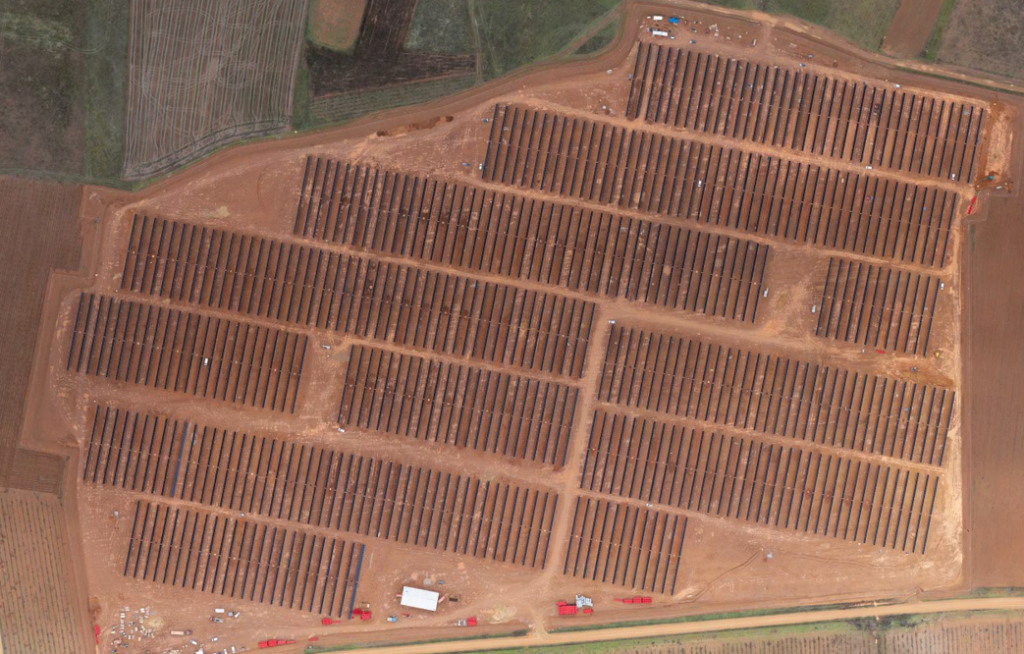
As a recent experience, SICE is currently executing a strategic photovoltaic project for the agricultural sector of Castilla y León. This involves a self-consumption photovoltaic plant of 11.48 MWp, consisting of 19,800 modules on driven pile structures across a surface area of 248,335 m². The electricity generated is intended to power the irrigation system of the Páramo Bajo Regants Community. This initiative will enhance the competitiveness and profitability of the operations of 6,700 agricultural professionals managing 24,000 hectares spread across about twenty municipalities in the provinces of León and Zamora.